Monday, August 8, 2011

The Early Warning Signs of Periodontal Disease

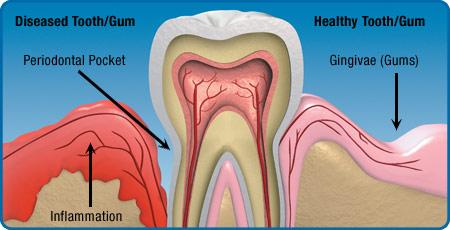
Periodontal disease is a bacterial infection of the gums and bone caused in part by dental plaque, the soft and sticky substance that forms on the teeth.  It is estimated to affect 4 out of every 5 people.  If the plaque is allowed to remain and grow on the teeth, an inflammation of the gums called gingivitis occurs.  As the disease progresses, the pockets infected with bacteria deepen by the decay of bone which holds the teeth in the mouth.  This bone decay if left untreated results in the loss of teeth.  Periodontal disease may progress painlessly and without warning until it is too late to save the teeth.  Periodontal disease usually progresses slowly, but can  have episodes of rapid progression.  With this in mind, please be aware of the following signs and symptoms:

*  Gums that bleed when you brush your teeth
*  Gums that are red, tender and swollen
*  Gaps forming between the teeth and gums
*  Teeth that are loose
*  Gaps forming between the teeth
*  Changes in the bite
*  Changes in the fit of a partial denture
*  Pus between your teeth and gums
*  Chronic bad breath or bad taste


If you or anyone you know is experiencing these symptoms, visit Dr. Dulski at Adult Dentistry of Rochester for a free exam and consultation.


Tags: Periodontal Disease, Gingivitis, Dental Plaque, Bad Breath

Thursday, July 28, 2011

Evidence Based Periodontal Treatment

At Adult Dentistry of Rochester, we do a periodontal examination at every oral health examination.  With the new information on the association of periodontal disease and systemic diseases, Dr. Dulski puts a lot of emphasis on assuring that the gums are healthy.  So, we routinely screen for the early warning signs of gum disease for all patients at the re-care visits with the hygienist.

We examine the gums with a blunt-end measuring device called a periodontal probe.  Any bleeding during probing means that there is an infection in the gums.  The infection is caused by bacteria.  Any probe readings greater than three indicates the tender, red, swollen gums of disease.  Larger numbers mean that the gum disease has spread from the gums to the supporting bone around the tooth and that the bone is beginning to deteriorate in that area.


Readings of ones, twos or threes with no bleeding indicates healthy gums.  Two or three bleeding points with a reading of  four indicates a local gum infection and commands special attention by the hygienist at the cleaning appointment.  Special brushing and flossing instructions and a re-evaluation on a six month re-care schedule follows. Six or eight bleeding points indicate a more generalized gum infection called gingivitis and more intense hygiene therapy and a three month re-care schedule with the hygienist.  Persistent gum infection can cause gum decay which can progress to the bone resulting in a condition called periodontitis.  A persistent gum and bone cavity with a reading of five requires teeth scaling to remove root deposits of toxic plaque and tartar and disinfection of the site with an antimicrobial such as Arestin to promote healing.  Healing and maintenance is closely monitored at three month re-care appointments with the hygienist.


Ultrasonic teeth scaling is one of the most effective procedures for removing plaque and tartar from the teeth.  An ultrasonic scaler consists of a small wand that produces a gentle vibration and flow of water.  As the tip moves along the tooth surface, its vibrations break up the plaque and tartar.  These vibrations also cause millions of microscopic bubbles to form in the water.  When the bubbles collapse, the energy that is released helps to dislodge the toxic deposits of plaque and tartar..  Ultrasonic teeth scaling can be more comfortable than using manual teeth scalers because the tip is extremely small and the action  more gentle to the gums.  In addition, we add an antibacterial solution, Peridex, to help disinfect the tissues to aid healing.


Arestin is used together with teeth scaling  to kill the bacteria that cause gum decay.  This is a cartridge filled with Arestin, an antibiotic in powder form.  After scaling, we apply the powder to your periodontal pocket where it combines with the moisture in the pocket and adheres immediately to the infected gum tissue.  The individual powder particles release a steady flow of the active ingredient, minocycline, a potent antibiotic.  The medication helps fight your infection for 21 days.  You should know that scaling and Arestin are not a cure for periodontal disease.  Once bone is lost, no amount of medication will bring it back.  And for periodontal therapy to be successful, you will need to be very thorough with your home care and continuous with your re-care schedule.  Visit www.dulski.com for a free periodontal exam and recommendations for a periodontal therapy and  re-care schedule designed to help you keep your healthy, beautiful smile.

Tags: Periodontal Exam, Periodontal Disease, Gum Disease, HygienistPeriodontitis, Arestin, Periodontal Therapy, Ultrasonic Teeth Scaliing 

Monday, July 11, 2011

Is Your Swimming Pool Safe for Your Teeth?

This summer, many people will escape the heat with a dip in their backyard pool.  However, researchers warn about the dangers of improper pool maintenance and enamel erosion.

"Improperly maintained pool chlorination in swimming pools can cause rapid and excessive erosion of dental enamel," says Dr. Leila Jahangiri , clinical associate professor and chair of the Department of Prosthodontics at the New York University College of Dentistry.  "It is a difficult balance to maintain pools properly, and proper pool chlorine and pH levels need to be monitored and maintained on a weekly basis.  If chemical levels are not properly maintained, pool water contact with teeth can cause serious enamel erosion."


Case studies show that serious enamel erosion occurs when the pH of the water ranges between 2.7 or acidic and 7.0 or neutral.  The more acidic the water and the longer the exposure to the acidity of the water, the more likely the erosion of the enamel.  The signs and symptoms of tooth erosion include teeth discoloration and tooth sensitivity.  As the white enamel that protects the teeth is eroded away, the underlying dentin, the softer, yellow and sensitive part of the tooth, is exposed, making the teeth appear more yellow and feel more sensitive.  If you notice any of these changes and swim frequently, visit Dr. Dulski at  Adult Dentistry of Rochester for a free exam and consultation to learn how to minimize and repair the damage.

Tags: Enamel ErosionTooth Sensitivity

Wednesday, June 22, 2011

The Problem With Amalgam (Silver) Fillings

The mouth in its ideal form is free of signs of decay and disease.  Unfortunately, often our mouths can appear less than ideal with unsightly dark silver fillings.  Now, there is a new kind of restoration available called composite fillings that replace dark silver fillings to make your mouth look natural and beautiful again.

In the past, when an old filling wore out or failed with new decay, the only option was to have another silver filling.  Unfortunately, silver fillings have several disadvantages.  First, with time, the edges of the fillings deteriorate and break through a process called metal fatigue.  When a filling breaks, it no longer seals the tooth and tooth decay begins again.  Second, silver fillings just fill holes.  They don't add strength to decayed teeth.  And, when they age, they expand which can further weaken and crack the remaining tooth structure.  The result is tooth fracture which can result in the need  for a crown to seal and protect the tooth.  Finally, silver fillings cause unsightly metal stains of the teeth and gums.

With advances in materials and techniques, we now have a material that avoids these problems - composite fillingsComposite fillings are tooth colored acrylics that are adhesively applied to the teeth in a process called bondingComposites not only look natural, they actually restore strength to the tooth while sealing and protecting the tooth.  For strong and natural looking teeth, Dr. Dulski uses composites exclusively as filling material at Adult Dentistry of Rochester.  For a free exam and consultation to discuss your alternative to silver fillings, visit http://www.dulski.com/.

Tags: Amalgam Fillings, Silver Fillings, Composite Fillings, Crowns

Monday, June 6, 2011

Common Questions About Porcelain Veneers

In an interview with Dr. Dulski about porcelain veneers, Ms. Deborah Jeanne Sergeant of In Good Health asks:

Ms. Sergeant:  What are the benefits that porcelain veneers offer?
Dr. Dulski:  How we perceive our smile and appearance affects our self-esteem, our moods and how we function in social and business relationships.  Common conditions that impact negatively on your smile include broken, cracked or worn teeth, discolored teeth, missing teth, crooked teeth, gaps between your teeth and/or "gummy smiles."  Ceramic restoration is the most durable and life-like way to replace damaged or lost enamel.  Veneers are more conservative of healthy tooth structure than full-coverage ceramic crowns.

Ms. Sergeant:  What are the risks involved?
Dr. Dulski:  As with any dental material that is used to restore teeth, there is limited useful life of the material.  Worn material requires replacement over time.  Consider a non-invasive procedure like orthodontics to close gaps to straighten teeth if the enamel is healthy and attractive.

Ms. Sergeant:  I've read that sometimes part of the tooth is ground off before a veneer is applied.  Wouldn't that harm the enamel?
Dr. Dulski:  The tooth is only as strong as the original tooth structure.  Healthy, intact enamel is necessary for a strong tooth that can chew comfortably and resist fracture.  Veneers are the most conservative replacement for damaged or lost enamel.  Thin veneers are the most conservative enhancement for unattractive enamel.

Ms. Sergeant:  Can debris get trapped between tooth and veneer thus endangering the tooth?
Dr. Dulski:  Porcelain veneers are bonded to the tooth using adhesive resins that seal out decay.  Daily brushing and flossing are necessary  to remove plaque, a film of bacteria that can build up on both natural and veneered teeth along the gum line.

Ms. Sergeant:  How long do veneers last?
Dr. Dulski:  Veneers, like crowns, last an average of 8 - 12 years.  Frequent visits with your dental hygiene coach, the hygienist, can help you prolong the life of your porcelain restorations.

Ms. Sergeant:  Once a veneer is applied, must the person have veneers for life?
Dr. Dulski:  Once enamel is removed, it cannot be replaced with anything as long-lasting.  Bonding damaged, lost or unattractive enamel with porcelain with the goal of preserving tooth structure is a reality today.


At Adult Dentistry of Rochester, Dr. Dulski supports the desirability of placing more conservative restorations to realize the financial and longevity benefits offered by more conservative restorative dentistry. Visit www.dulski.com to learn how contemporary methods give us the tools to give you a gorgeous, bright smile with minimally invasive treatments and fewer repeat visits.

Tags: Porcelain VeneersConservative Restorative DentistryDental Bonding

Thursday, May 26, 2011

Preventive Dentistry

Preventive dentistry is a philosophy that takes advantage of the latest technology and techniques to help keep your teeth healthy and beautiful.  The principles of  preventive dentistry are to prevent tooth decay, detect and treat decay as early as possible, preserve the maximum amount of tooth structure, and restore your teeth comfortably with tooth-colored materials.  These same principles of early detection and treatment to preserve supporting tissue also apply to gum disease to prevent tooth loss.

As a first step, we'll talk with you about your diet, home care routine, and health history to help you lower your risk for tooth decay.  If you are at high risk, we may recommend special fluoride tooth paste, mouth rinses, sealants, or other treatments to help prevent decay.  We'll also perform a thorough examination.  And, if we suspect that the decay has already begun, we will use extremely small instruments to remove the decay in the pits and grooves or in-between areas of teeth where decay begins.  Fortunately, these methods are gentle on teeth.


If teeth are at risk of decay, we may place sealants on the biting surfaces of teeth to prevent future damage.  If teeth are already decayed, then we will remove the decay and bond in a small tooth-colored filling to protect and restore the tooth.  At Adult Dentistry of Rochester, preventive dentistry techniques allow us to detect problems early and help you keep your healthy, beautiful smile.  We invite you to visit http://www.dulski.com/ for a free comprehensive exam. We think this is the best way for you to get acquainted with our advanced, comfort-conscience,

Tags: Preventive DentistryDental SealantsTooth-Colored FillingsDental BondingDiet and Risk of Tooth Decay

Thursday, May 19, 2011

Seven Factors You Can't Ignore

Gum disease is a chronic bacterial infection that triggers an inflammatory response in your body and can lead to tooth loss.  Scientists believe that this inflammatory process my be linked to other inflammatory diseases such as heart disease, stroke, and Alzheimer's disease.  The incidence of gum disease effects over 50% of the adult population. There are seven factors that could make you vulnerable to developing gum disease:

1)  Tobacco and Alcohol.  Smoking or chewing tobacco and drinking alcohol are leading causes of gum disease and can lead to oral cancer.  Doing both could put you at 15 times greater risk that others.
2)  Genetic Susceptibility.  About 30% of the population inherits the tendency to be six times more at risk for gum disease.
3)  Hormonal Changes.  Life stages that bring natural changes in hormone levels include puberty, pregnancy, menopause, and andropause.
4)  Stress.  Stress can make it more difficult for you to fight off oral and other infections.
5)  Diabetes.  Diabetics are at higher risk for infections including gum diseases which can make it more difficult to control blood sugar.
6)  Clenching or Grinding Teeth.  Excess force on the supporting tissues of your teeth could speed their deterioration.
7)  Avoiding Dental Visits.  Regular exams and confirmation of proper home care techniques can help you prevent gum disease.  At Adult Dentistry of Rochester, we can identify gum disease before you can and help you to halt its progression.  It's critical to your health, and the health of your family, to have the condition of  your teeth and gums checked now.  Please visit us at http://www.dulski.com/ for your free exam and consultation.

Tags: Gum Disease, TMD, Preventive Dentistry, Periodontal Disease