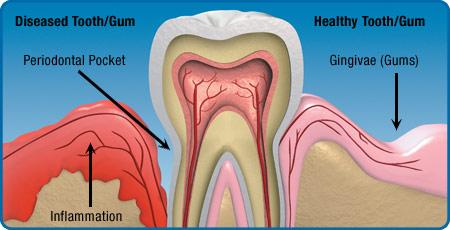
Inflammation is from the Latin, inflammare, which means to set on fire and is part of the bodies response to disease causing bacteria and toxins. The body initiates healing from an injury like a cut with a reaction that produces red, tender and swollen tissue. This reaction allows healing cells from the blood stream to infiltrate the injured tissue to kill bacteria, remove damaged cells and grow new tissue. The inflammation of the typical healing process is temporary.
It is when inflammation is not quickly resolved with healing that local inflammatory factors can spread throughout the whole body. Inflammation can then become a wildfire that spreads out of control causing tissue destruction distant to the site of the original infection. This chronic inflammation can result in atherosclerosis, the blood vessel disease of heart attacks and stokes. Evidence of chronic inflammation in the mouth is the red, tender and swollen gums of periodontal disease. The earliest and easiest stage of periodontal disease to treat is gingivitis.
That's why your routine dental check-ups and cleanings are so important - not just for the health of your teeth and gums, but for your general health. Visit Adult Dentistry of Rochester for your next periodic dental check-up and cleaning where we check the health of the gums with a complete periodontal exam at every visit and thoroughly remove the deposits of bacterial plaque which fuel the fire of gingival inflamation.
Tags: Periodontal Disease, Gingivitis, Periodontal Exam
Monday, October 3, 2011
Tuesday, September 27, 2011
Periodontal Maintenance
A routine oral prophylaxis (routine teeth cleaning) includes scaling or polishing procedures to remove plaque, calculus and stains from the crowns of teeth. A routine cleaning is performed on healthy tissue or in the presence of inflammation, gingivitis, the response of healthy tissue to the toxic deposits of bacterial plaque and calculus. A routine cleaning is performed every 3,4 or 6 months to maintain healthy gums or reverse a gingivitis to return the mouth to health.
Periodontal maintenance is initiated following the treatment of periodontal disease, the loss of tooth support to gum and bone decay resulting in unsupported and exposed root surfaces. Periodontal maintenance includes the removal of bacterial plaque and calculus from the crowns and exposed root surfaces of teeth above the gum-line and deposits on the root surfaces of teeth below the gum-line. Periodontal maintenance is performed every 3 months to prevent the progression of periodontal disease.
Once tooth support has been lost, it cannot be restored. Tooth loss in periodontal patients has been shown in studies to be inversely proportional to the frequency of periodontal maintenance. Ten years following completion of periodontal therapy, patients who had received periodontal maintenance had significantly less progressive gum and bone decay and reduced tooth loss compared to patients who had not received periodontal maintenance. In fact, numerous studies have demonstrated the effectiveness of periodontal maintenance and have shown that progressive periodontitis can be prevented or limited by optimal personal oral hygiene and thorough periodontal maintenance. Since patients are rarely completely effective in removing plaque at home, 3 month periodontal maintenance eliminates or reduces the toxic effects of bacterial plaque on teeth and supporting tissues.
Patients with a history of periodontitis require continuing periodontal maintenance since brushing and flossing alone has not been shown to control the progression of attachment loss. Occasionally, despite the best efforts of the dentist and hygienist, some patients may suffer tooth loss despite continuous periodontal maintenance. Additional diagnostic information, such as microbial and genetic testing, as well as antimicrobial therapy and periodontal surgery my be required for these patients. For a free periodontal exam which includes an update of your medical and dental histories, extra-oral and intra-oral soft tissue examination, dental examination, periodontal evaluation, implant evaluation, and radiographic review, visit Adult Dentistry of Rochester.
Tags: Oral Prophylaxis, Periodontal Maintenance, Teeth Cleaning, Periodontal Disease, Gingivitis, Gum Disease
Periodontal maintenance is initiated following the treatment of periodontal disease, the loss of tooth support to gum and bone decay resulting in unsupported and exposed root surfaces. Periodontal maintenance includes the removal of bacterial plaque and calculus from the crowns and exposed root surfaces of teeth above the gum-line and deposits on the root surfaces of teeth below the gum-line. Periodontal maintenance is performed every 3 months to prevent the progression of periodontal disease.
Once tooth support has been lost, it cannot be restored. Tooth loss in periodontal patients has been shown in studies to be inversely proportional to the frequency of periodontal maintenance. Ten years following completion of periodontal therapy, patients who had received periodontal maintenance had significantly less progressive gum and bone decay and reduced tooth loss compared to patients who had not received periodontal maintenance. In fact, numerous studies have demonstrated the effectiveness of periodontal maintenance and have shown that progressive periodontitis can be prevented or limited by optimal personal oral hygiene and thorough periodontal maintenance. Since patients are rarely completely effective in removing plaque at home, 3 month periodontal maintenance eliminates or reduces the toxic effects of bacterial plaque on teeth and supporting tissues.
Patients with a history of periodontitis require continuing periodontal maintenance since brushing and flossing alone has not been shown to control the progression of attachment loss. Occasionally, despite the best efforts of the dentist and hygienist, some patients may suffer tooth loss despite continuous periodontal maintenance. Additional diagnostic information, such as microbial and genetic testing, as well as antimicrobial therapy and periodontal surgery my be required for these patients. For a free periodontal exam which includes an update of your medical and dental histories, extra-oral and intra-oral soft tissue examination, dental examination, periodontal evaluation, implant evaluation, and radiographic review, visit Adult Dentistry of Rochester.
Tags: Oral Prophylaxis, Periodontal Maintenance, Teeth Cleaning, Periodontal Disease, Gingivitis, Gum Disease
Thursday, September 1, 2011
Are You At Risk For Periodontal Disease?
There are several factors that increase the risk of periodontal disease, an infection that causes decay in the gum and bone supporting teeth. These risk factors are:
Smoking or chewing tobacco - not only is periodontal disease more prevalent in smokers, periodontal treatment is less successful in those individuals who smoke.
Diseases that affect the whole body - such as diabetes, blood cell disorders, and, HIV-AIDS are among the diseases that can lower resistance to infection, making periodontal disease more likely and severe.
Medications - steroids, anti-seizure drugs, cancer therapy drugs, blood pressure drugs and birth control pills - can affect the gums. Some of these medications have the side effect of reducing salivary flow which lowers the cleansing and buffering effect of saliva resulting in increased plaque accumulation and acid attack which causes tooth decay and gum disease.
Teens, pregnant women, and those taking birth control pills face changes in the body's hormone levels which can cause the gum tissue to be more inflamed by the toxins in bacterial plaque.
Genes play a role. Some patients may have a gene that causes the gums to become more inflamed in response to bacterial plaque. The result is more severe and rapid progression of periodontal disease. If your parents wear dentures or you have a family history of tooth loss due to gum disease, then you may carry this gene.
The specific types of bacteria that cause periodontal disease are passed from mother to children due to the intimate physical contact of child rearing, or between partners through the saliva. You help your children avoid gum disease by taking care of your own oral health. Some parents mistakenly think that they are caring for their children by neglecting their own health. For a free periodontal exam and consultation with Dr. Dulski to assess your risk for periodontal disease, visit Adult Dentistry of Rochester.
Tags: Periodontal Disease, Gum Disease
Smoking or chewing tobacco - not only is periodontal disease more prevalent in smokers, periodontal treatment is less successful in those individuals who smoke.
Diseases that affect the whole body - such as diabetes, blood cell disorders, and, HIV-AIDS are among the diseases that can lower resistance to infection, making periodontal disease more likely and severe.
Medications - steroids, anti-seizure drugs, cancer therapy drugs, blood pressure drugs and birth control pills - can affect the gums. Some of these medications have the side effect of reducing salivary flow which lowers the cleansing and buffering effect of saliva resulting in increased plaque accumulation and acid attack which causes tooth decay and gum disease.
Teens, pregnant women, and those taking birth control pills face changes in the body's hormone levels which can cause the gum tissue to be more inflamed by the toxins in bacterial plaque.
Genes play a role. Some patients may have a gene that causes the gums to become more inflamed in response to bacterial plaque. The result is more severe and rapid progression of periodontal disease. If your parents wear dentures or you have a family history of tooth loss due to gum disease, then you may carry this gene.
The specific types of bacteria that cause periodontal disease are passed from mother to children due to the intimate physical contact of child rearing, or between partners through the saliva. You help your children avoid gum disease by taking care of your own oral health. Some parents mistakenly think that they are caring for their children by neglecting their own health. For a free periodontal exam and consultation with Dr. Dulski to assess your risk for periodontal disease, visit Adult Dentistry of Rochester.
Tags: Periodontal Disease, Gum Disease
Tuesday, August 9, 2011
Dental Care For Senior Adults
As we age, we notice graying hair, more frequent aches and pains and wrinkles. Our teeth and mouths are also affected by aging.
Dental cavities are not just for kids. As we age, receding gums can expose the unprotected root surfaces of teeth resulting in root cavities. Many seniors also have a number of old fillings. On average, fillings last 8 - 10 years. As fillings age, leakage and decay is a common problem.
Gum disease is the major reason for tooth loss in adults of all ages. Infected gums if left untreated slowly detach from the teeth. Deepening infection can involve the underlying bone resulting in bone decay. Eventually the teeth loosen and are lost. Some medical diseases, certain medications, dentures and bridges that don't fit properly, poor diets and poor oral hygiene can increase the severity of gum disease.
Dr. Dulski believes that every tooth in your mouth plays an important role in speaking, chewing and maintaining proper alignment of other teeth. Tooth loss is not an inevitable result of aging, but if you do lose teeth, they should be replaced for your mouth the function properly.
If most of the teeth are missing, a partial denture or complete denture can restore the mouth to function and improve appearance and restore personal self-esteem. A more natural option to replacing lost teeth in terms of fit, comfort and appearance is dental implants. Dental implants attach directly to the jawbone. Not everyone is a candidate for dental implants because the patient must be in good general and oral health and have adequate jawbone remaining to secure the dental implant. Dr. Dulski will advise you if this is an option for you.
What can you do to prevent dental problems? Sugars and starches are changed by bacteria in plaque to acids which attack tooth enamel. Limiting the number of times you snack along with brushing and flossing daily can help save your teeth from tooth decay. Studies show that fluoride is just as effective in preventing tooth cavities in adult as it is in children. Toothpastes containing fluoride can help reduce tooth decay even more that brushing and flossing alone.
Regular dental check-ups are important for seniors, whether or not they have their natural teeth. Besides evaluating and treating existing dental problems, Dr. Dulski also looks for more serious health problems such as oral cancer. The majority of oral cancers occur in people older than 45 years of age. Symptoms of oral cancer include sores, swelling or discoloration of the tongue, lips, cheek, throat, jawbone or salivary glands. If you notice any of these symptoms, call Dr. Dulski immediately for a examination.
Aging also yellows teeth. A number of cosmetic dental procedures can improve your smile. Bleaching can whiten stained teeth, bonding and porcelain veneers can cover stains, restore chipped teeth, close gaps or reshape malformed teeth. Visit Adult Dentistry of Rochester to learn how Dr. Dulski can keep you smiling for years to come.
Tags: Dental Cavities, Gum Disease, Partial Dentures, Complete Dentures, Dental Implants, Oral Cancer, Porcelain Veneers
Dental cavities are not just for kids. As we age, receding gums can expose the unprotected root surfaces of teeth resulting in root cavities. Many seniors also have a number of old fillings. On average, fillings last 8 - 10 years. As fillings age, leakage and decay is a common problem.
Gum disease is the major reason for tooth loss in adults of all ages. Infected gums if left untreated slowly detach from the teeth. Deepening infection can involve the underlying bone resulting in bone decay. Eventually the teeth loosen and are lost. Some medical diseases, certain medications, dentures and bridges that don't fit properly, poor diets and poor oral hygiene can increase the severity of gum disease.
Dr. Dulski believes that every tooth in your mouth plays an important role in speaking, chewing and maintaining proper alignment of other teeth. Tooth loss is not an inevitable result of aging, but if you do lose teeth, they should be replaced for your mouth the function properly.
If most of the teeth are missing, a partial denture or complete denture can restore the mouth to function and improve appearance and restore personal self-esteem. A more natural option to replacing lost teeth in terms of fit, comfort and appearance is dental implants. Dental implants attach directly to the jawbone. Not everyone is a candidate for dental implants because the patient must be in good general and oral health and have adequate jawbone remaining to secure the dental implant. Dr. Dulski will advise you if this is an option for you.
What can you do to prevent dental problems? Sugars and starches are changed by bacteria in plaque to acids which attack tooth enamel. Limiting the number of times you snack along with brushing and flossing daily can help save your teeth from tooth decay. Studies show that fluoride is just as effective in preventing tooth cavities in adult as it is in children. Toothpastes containing fluoride can help reduce tooth decay even more that brushing and flossing alone.
Regular dental check-ups are important for seniors, whether or not they have their natural teeth. Besides evaluating and treating existing dental problems, Dr. Dulski also looks for more serious health problems such as oral cancer. The majority of oral cancers occur in people older than 45 years of age. Symptoms of oral cancer include sores, swelling or discoloration of the tongue, lips, cheek, throat, jawbone or salivary glands. If you notice any of these symptoms, call Dr. Dulski immediately for a examination.
Aging also yellows teeth. A number of cosmetic dental procedures can improve your smile. Bleaching can whiten stained teeth, bonding and porcelain veneers can cover stains, restore chipped teeth, close gaps or reshape malformed teeth. Visit Adult Dentistry of Rochester to learn how Dr. Dulski can keep you smiling for years to come.
Tags: Dental Cavities, Gum Disease, Partial Dentures, Complete Dentures, Dental Implants, Oral Cancer, Porcelain Veneers
Monday, August 8, 2011
The Early Warning Signs of Periodontal Disease
Periodontal disease is a bacterial infection of the gums and bone caused in part by dental plaque, the soft and sticky substance that forms on the teeth. It is estimated to affect 4 out of every 5 people. If the plaque is allowed to remain and grow on the teeth, an inflammation of the gums called gingivitis occurs. As the disease progresses, the pockets infected with bacteria deepen by the decay of bone which holds the teeth in the mouth. This bone decay if left untreated results in the loss of teeth. Periodontal disease may progress painlessly and without warning until it is too late to save the teeth. Periodontal disease usually progresses slowly, but can have episodes of rapid progression. With this in mind, please be aware of the following signs and symptoms:
* Gums that bleed when you brush your teeth
* Gums that are red, tender and swollen
* Gaps forming between the teeth and gums
* Teeth that are loose
* Gaps forming between the teeth
* Changes in the bite
* Changes in the fit of a partial denture
* Pus between your teeth and gums
* Chronic bad breath or bad taste
If you or anyone you know is experiencing these symptoms, visit Dr. Dulski at Adult Dentistry of Rochester for a free exam and consultation.
Tags: Periodontal Disease, Gingivitis, Dental Plaque, Bad Breath
* Gums that bleed when you brush your teeth* Gums that are red, tender and swollen
* Gaps forming between the teeth and gums
* Teeth that are loose
* Gaps forming between the teeth
* Changes in the bite
* Changes in the fit of a partial denture
* Pus between your teeth and gums
* Chronic bad breath or bad taste
If you or anyone you know is experiencing these symptoms, visit Dr. Dulski at Adult Dentistry of Rochester for a free exam and consultation.
Tags: Periodontal Disease, Gingivitis, Dental Plaque, Bad Breath
Thursday, July 28, 2011
Evidence Based Periodontal Treatment
At Adult Dentistry of Rochester, we do a periodontal examination at every oral health examination. With the new information on the association of periodontal disease and systemic diseases, Dr. Dulski puts a lot of emphasis on assuring that the gums are healthy. So, we routinely screen for the early warning signs of gum disease for all patients at the re-care visits with the hygienist.
We examine the gums with a blunt-end measuring device called a periodontal probe. Any bleeding during probing means that there is an infection in the gums. The infection is caused by bacteria. Any probe readings greater than three indicates the tender, red, swollen gums of disease. Larger numbers mean that the gum disease has spread from the gums to the supporting bone around the tooth and that the bone is beginning to deteriorate in that area.
Readings of ones, twos or threes with no bleeding indicates healthy gums. Two or three bleeding points with a reading of four indicates a local gum infection and commands special attention by the hygienist at the cleaning appointment. Special brushing and flossing instructions and a re-evaluation on a six month re-care schedule follows. Six or eight bleeding points indicate a more generalized gum infection called gingivitis and more intense hygiene therapy and a three month re-care schedule with the hygienist. Persistent gum infection can cause gum decay which can progress to the bone resulting in a condition called periodontitis. A persistent gum and bone cavity with a reading of five requires teeth scaling to remove root deposits of toxic plaque and tartar and disinfection of the site with an antimicrobial such as Arestin to promote healing. Healing and maintenance is closely monitored at three month re-care appointments with the hygienist.
Ultrasonic teeth scaling is one of the most effective procedures for removing plaque and tartar from the teeth. An ultrasonic scaler consists of a small wand that produces a gentle vibration and flow of water. As the tip moves along the tooth surface, its vibrations break up the plaque and tartar. These vibrations also cause millions of microscopic bubbles to form in the water. When the bubbles collapse, the energy that is released helps to dislodge the toxic deposits of plaque and tartar.. Ultrasonic teeth scaling can be more comfortable than using manual teeth scalers because the tip is extremely small and the action more gentle to the gums. In addition, we add an antibacterial solution, Peridex, to help disinfect the tissues to aid healing.
Arestin is used together with teeth scaling to kill the bacteria that cause gum decay. This is a cartridge filled with Arestin, an antibiotic in powder form. After scaling, we apply the powder to your periodontal pocket where it combines with the moisture in the pocket and adheres immediately to the infected gum tissue. The individual powder particles release a steady flow of the active ingredient, minocycline, a potent antibiotic. The medication helps fight your infection for 21 days. You should know that scaling and Arestin are not a cure for periodontal disease. Once bone is lost, no amount of medication will bring it back. And for periodontal therapy to be successful, you will need to be very thorough with your home care and continuous with your re-care schedule. Visit www.dulski.com for a free periodontal exam and recommendations for a periodontal therapy and re-care schedule designed to help you keep your healthy, beautiful smile.
Tags: Periodontal Exam, Periodontal Disease, Gum Disease, Hygienist, Periodontitis, Arestin, Periodontal Therapy, Ultrasonic Teeth Scaliing
We examine the gums with a blunt-end measuring device called a periodontal probe. Any bleeding during probing means that there is an infection in the gums. The infection is caused by bacteria. Any probe readings greater than three indicates the tender, red, swollen gums of disease. Larger numbers mean that the gum disease has spread from the gums to the supporting bone around the tooth and that the bone is beginning to deteriorate in that area.
Readings of ones, twos or threes with no bleeding indicates healthy gums. Two or three bleeding points with a reading of four indicates a local gum infection and commands special attention by the hygienist at the cleaning appointment. Special brushing and flossing instructions and a re-evaluation on a six month re-care schedule follows. Six or eight bleeding points indicate a more generalized gum infection called gingivitis and more intense hygiene therapy and a three month re-care schedule with the hygienist. Persistent gum infection can cause gum decay which can progress to the bone resulting in a condition called periodontitis. A persistent gum and bone cavity with a reading of five requires teeth scaling to remove root deposits of toxic plaque and tartar and disinfection of the site with an antimicrobial such as Arestin to promote healing. Healing and maintenance is closely monitored at three month re-care appointments with the hygienist.
Ultrasonic teeth scaling is one of the most effective procedures for removing plaque and tartar from the teeth. An ultrasonic scaler consists of a small wand that produces a gentle vibration and flow of water. As the tip moves along the tooth surface, its vibrations break up the plaque and tartar. These vibrations also cause millions of microscopic bubbles to form in the water. When the bubbles collapse, the energy that is released helps to dislodge the toxic deposits of plaque and tartar.. Ultrasonic teeth scaling can be more comfortable than using manual teeth scalers because the tip is extremely small and the action more gentle to the gums. In addition, we add an antibacterial solution, Peridex, to help disinfect the tissues to aid healing.
Arestin is used together with teeth scaling to kill the bacteria that cause gum decay. This is a cartridge filled with Arestin, an antibiotic in powder form. After scaling, we apply the powder to your periodontal pocket where it combines with the moisture in the pocket and adheres immediately to the infected gum tissue. The individual powder particles release a steady flow of the active ingredient, minocycline, a potent antibiotic. The medication helps fight your infection for 21 days. You should know that scaling and Arestin are not a cure for periodontal disease. Once bone is lost, no amount of medication will bring it back. And for periodontal therapy to be successful, you will need to be very thorough with your home care and continuous with your re-care schedule. Visit www.dulski.com for a free periodontal exam and recommendations for a periodontal therapy and re-care schedule designed to help you keep your healthy, beautiful smile.
Tags: Periodontal Exam, Periodontal Disease, Gum Disease, Hygienist, Periodontitis, Arestin, Periodontal Therapy, Ultrasonic Teeth Scaliing
Monday, July 11, 2011
Is Your Swimming Pool Safe for Your Teeth?
This summer, many people will escape the heat with a dip in their backyard pool. However, researchers warn about the dangers of improper pool maintenance and enamel erosion.
"Improperly maintained pool chlorination in swimming pools can cause rapid and excessive erosion of dental enamel," says Dr. Leila Jahangiri , clinical associate professor and chair of the Department of Prosthodontics at the New York University College of Dentistry. "It is a difficult balance to maintain pools properly, and proper pool chlorine and pH levels need to be monitored and maintained on a weekly basis. If chemical levels are not properly maintained, pool water contact with teeth can cause serious enamel erosion."
Case studies show that serious enamel erosion occurs when the pH of the water ranges between 2.7 or acidic and 7.0 or neutral. The more acidic the water and the longer the exposure to the acidity of the water, the more likely the erosion of the enamel. The signs and symptoms of tooth erosion include teeth discoloration and tooth sensitivity. As the white enamel that protects the teeth is eroded away, the underlying dentin, the softer, yellow and sensitive part of the tooth, is exposed, making the teeth appear more yellow and feel more sensitive. If you notice any of these changes and swim frequently, visit Dr. Dulski at Adult Dentistry of Rochester for a free exam and consultation to learn how to minimize and repair the damage.
Tags: Enamel Erosion, Tooth Sensitivity
"Improperly maintained pool chlorination in swimming pools can cause rapid and excessive erosion of dental enamel," says Dr. Leila Jahangiri , clinical associate professor and chair of the Department of Prosthodontics at the New York University College of Dentistry. "It is a difficult balance to maintain pools properly, and proper pool chlorine and pH levels need to be monitored and maintained on a weekly basis. If chemical levels are not properly maintained, pool water contact with teeth can cause serious enamel erosion."
Case studies show that serious enamel erosion occurs when the pH of the water ranges between 2.7 or acidic and 7.0 or neutral. The more acidic the water and the longer the exposure to the acidity of the water, the more likely the erosion of the enamel. The signs and symptoms of tooth erosion include teeth discoloration and tooth sensitivity. As the white enamel that protects the teeth is eroded away, the underlying dentin, the softer, yellow and sensitive part of the tooth, is exposed, making the teeth appear more yellow and feel more sensitive. If you notice any of these changes and swim frequently, visit Dr. Dulski at Adult Dentistry of Rochester for a free exam and consultation to learn how to minimize and repair the damage.
Tags: Enamel Erosion, Tooth Sensitivity
Subscribe to:
Posts (Atom)